Hello everyone, this month’s newsletter comes from Carter Schaaf, our acquisitions analyst at Flex Real Estate.
This month we are going to discuss a macroeconomic topic that is beginning to affect nearly every industry across the globe, AI.
Citrini Research released an article February 22nd called “The 2028 Global Intelligence Crisis”. This article set in June 2028 chronicles a scenario regarding the future of AI and gained a lot of traction across white-collar America, impacting markets and creating further AI concern. This article is the main reason behind this month’s newsletter topic and the basis for much of the dystopia section. I recommend giving it a read if you have a chance.
Block, the financial services company behind Square, Cash App, and more, did exactly what this article states, laying off 40% of their workforce February 26th, resulting in one of the largest mass layoffs as a percentage of total employees in Fortune 500 history.
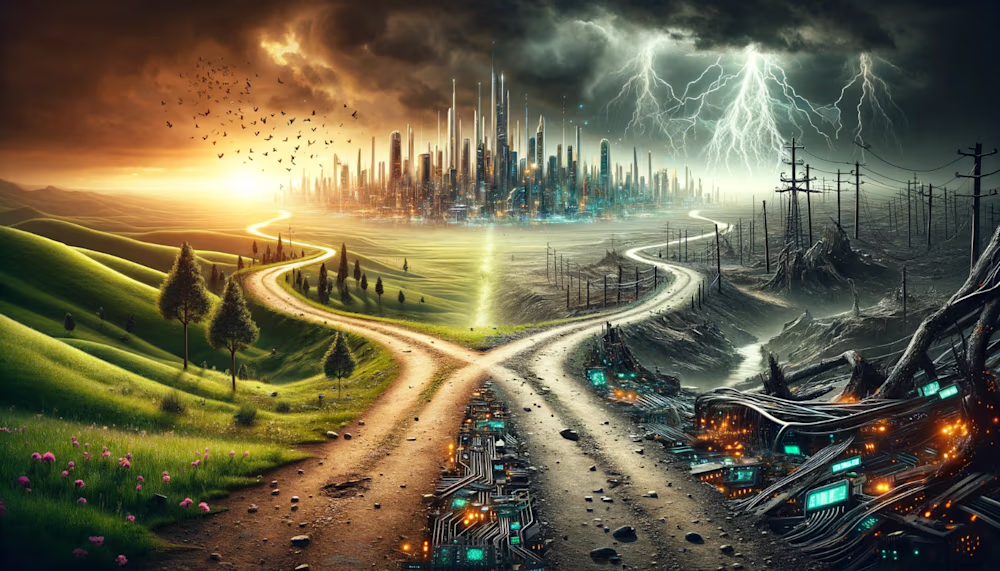
AI is seemingly at the top of almost every news headline from threats of complete economic collapse to promises of work being optional (Thanks, Elon!). Amidst all these conflicting opinions on the future of AI it can be hard to decipher what is just noise and what can be considered a realistic prediction. While I won’t pretend to be any sort of expert, I believe the answer lies somewhere between an AI dystopia and an AI utopia (the boring answer).
The Dystopia
The pessimistic AI writers take the stance that AI will rapidly replace the majority of white-collar jobs, leaving many educated Americans, who had high-paying careers, jobless and taking drastic pay cuts just to find work that will sustain their ability to live. They predict that AI will continuously consume jobs, creating an economic recession with no natural brake.
A traditional economic recession follows the path of overbuilding, leading to a construction slowdown, lower rates, rise in demand, new construction, and overbuilding, and the cycle continues.
The AI recession doesn’t follow the same rules. As AI investment increases within the economy, companies need fewer workers, leading to white-collar layoffs. With white-collar workers accounting for 50% of employment and 75% of discretionary consumer spending in the U.S., less money is spent, weakening the economy and further prompting companies to invest more in AI to protect margins. No natural break, no cyclical nature, no reinvestment in people. Instead, companies continuously increase their investment in AI, replacing employees’ layer by layer until only executives remain. The AI recession results in continued replacement without self-correction, culminating in a collapsed economy.
All of a sudden, the white-collar team lead making $200,000 a year loses their job, and, with all other white-collar team leads making $200,000 a year losing theirs too, the market for $100,000-a-year team leads becomes oversaturated and overqualified. This continues to compress downwards until there are triple the number of DoorDash drivers as three years ago. And don’t forget, no one has the discretionary capital to buy DoorDash anymore!
All the while, the mortgage market is collapsing because people who were once considered AAA credit are making 1/5 of what they used to, private credit defaults occur in every facet, and the government collapses after losing billions on tax income. (Although we all know they are the one squirrel who will always find their nut.)
The Utopia
The optimistic AI writers take a drastically different approach, stating work will be optional in 15 years and there will be a universal high income that will pay for living expenses and anything you can think of. AI will replace the monotonous tasks of life and allow humans to focus on their true interests, spending their time how they please.
Tasks become simpler, dreams become reality – ask AI, and it will deliver. Productivity reaches an all-time high because everyone can use AI to advance their ideas. People are not replaced; they are given leverage. AI creates new jobs due to the expansion of new industries and, in turn, the expansion of the economy.
Innovation reaches new heights, with advancements in healthcare, transportation, scientific discovery, cybersecurity, agriculture practices, climate change mitigation, and more. As AI evolves, so does humanity, working together to create a better future for people around the world. At the end of the day, AI is created to think like humans, to expand the capabilities of the human race, not destroy it.
The Middle Ground
All the AI articles that you may read, whether pessimistic or optimistic, have one thing in common; they assume 100% adoption of AI across all sectors and territories of the economy, a very unrealistic standard. Studies show that only 12% of working age adults use AI daily and just north of 50% have used it at all.
In reality, the truth about the future of AI lies somewhere between these two extremes. At least, within the next 20 years, the economy will not fall into collapse, and work will not be optional. AI will replace jobs but will also create new ones, although I do believe more will be replaced than created. The human factor is very real and is not going anywhere; people will choose to wait an extra two minutes for coffee to see a smiling face instead of being served by a robot. Trust in relationships will prevail when the decision to switch to an AI financial advisor is offered, and human perception will still be imperative when deciding whether to buy a building or not 😉.
As it always seems to do, the boring answer prevails. AI is a helpful tool that can and will transform various parts of everyday life, but evil robots don’t seem to be on the horizon just yet.
Reply to this email and let me know if there are any specific topics you would like to hear about next. Thank you for reading, and stay tuned for Andrew's return in the March Focus!




.png?upscale=true&width=400&upscale=true&name=Untitled%20design%20(36).png)


